
The Odyssey: Defying the Audience, Not the Gods
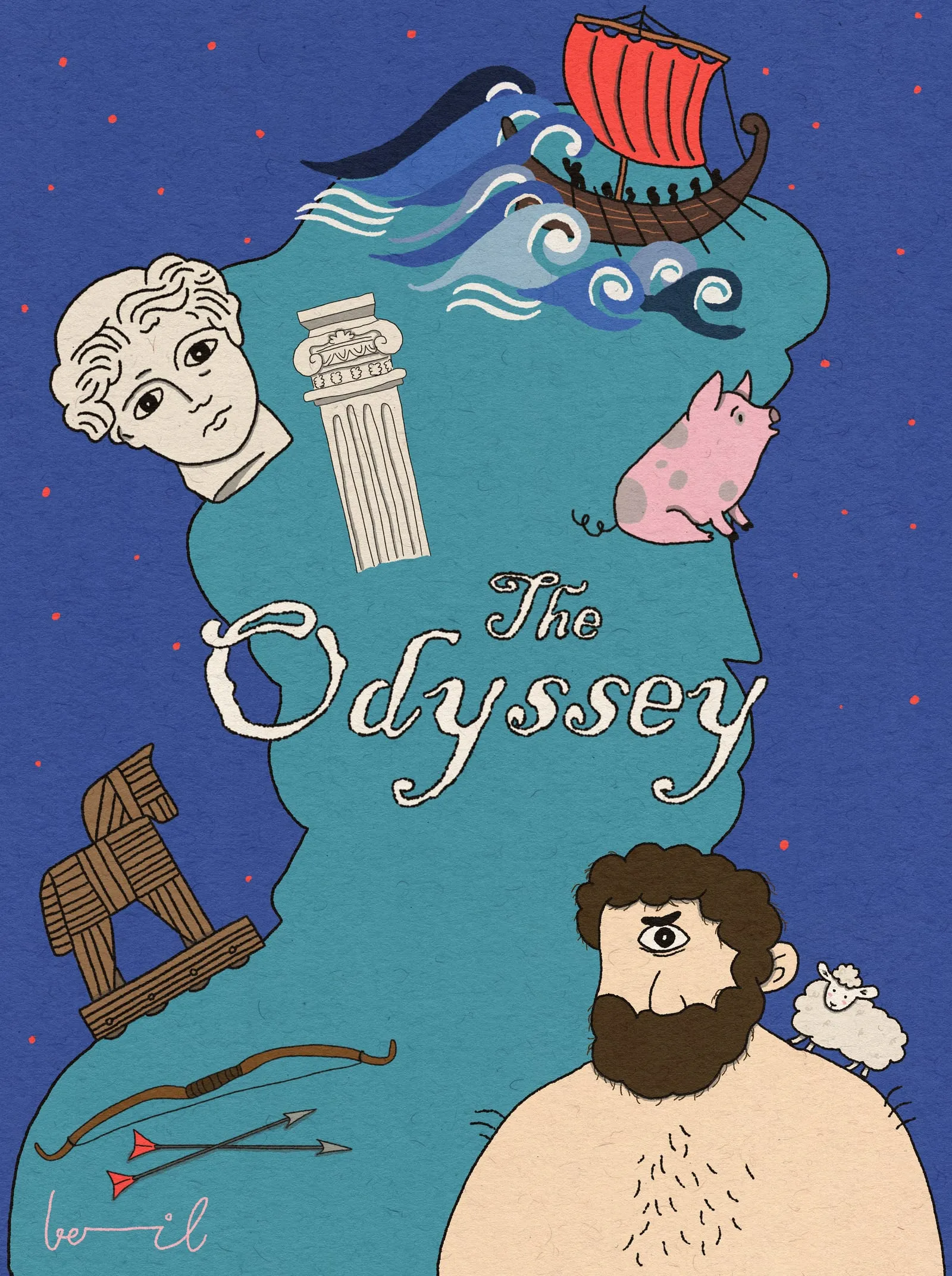
Of course, the headline doesn’t hold for every viewer. After seeing the film, I lay in wait on social media and snickered as this ‘historical’ epic adaptation opened a wound in a certain slice of the audience. As an assistant director and a dropout of an Ancient Greek language and literature program, my humble knowledge of Homer was most pleased by Lupita Nyong’o, who is not Greek (or, ahem, doesn’t look Greek), playing Helen of Troy in an epic with Sirens and Cyclopes. It’s just like Diane Kruger playing the same character in Wolfgang Petersen’s “Troy”. I was too young then, and my internet skills too limited, to research it, but I never saw anyone object to a German actress playing one of Zeus’s children, not in 2004 when the film came out and not today. So if we set the manufactured arguments aside and start enjoying this adaptation, which has sparked radical debates not only over the actors’ races but over the story’s flow as well, a brand new truth jumps out at us: The Odyssey (2026) is the Titanic (1997) of the new generation.
A bold sentence for both Titanic fans and haters, I know. But hold on. I’ll get there.
Penelope
When the first news about the film started to drop, the first thing I wondered was how Penelope would be handled and portrayed. The Odyssey has mostly reached the market through translations by male translators, in which the man is the absolute hero and symbol of strength and the woman is a passive character who either drags him down or merely helps him (he suffers for 20 years to get home while she waits as a docile, faithful wife, or she is the bane of his existence). I worried the poem, and Penelope with it, would be wasted in Nolan’s hands, because the women in Nolan’s films can sometimes fit that description too.
The epic says something else: the love of Odysseus and Penelope is a love that can endure twenty years of longing precisely because they are soul mates. If we compare the main characters of the Iliad and the Odyssey:
Achilles = Muscle power, fighting skill, rage
Odysseus = Brain power, strategic skill, patience
Fine, but…
Penelope too = Brain power, strategic skill, patience.
It is perfectly predictable that an army that couldn’t breach the walls would win the war by catching the city off guard. The outcome of that morally debatable decision is the same: Odysseus tricks the Trojans and ends the war. I would have loved to see that same Odysseus stripped of his army and armor, alone against dozens of invaders in his own home, a man who bends time to his will. Because when this epic, which comes from an era dominated by a belief in many gods, is adapted for our day, Penelope is represented as a fairly loyal, well-behaved, sweet woman. And that’s because today’s gender awareness creates more fear around masculinity than it did 3,000 years ago. The way Penelope fights her own battle with her wits and patience, mirroring Odysseus’s journey, hits the panic button in men who carry internalized (or plainly outward) misogyny.
At their core they are the same character: smart, strategic, fighters. And this is rendered deliciously through Emily Wilson’s translation of the Odyssey, which inspired the film and in which women characters, misrepresented for ages, finally find their voice. As for the performance of native New Yorker Anne Hathaway, there is nothing to say; it’s simply great.
She, Circe
Samantha Morton, from Nottingham, England, in her performance as the Greek witch Circe, became the second actor applauded on Nolan’s set after Heath Ledger’s Joker. She deserves it. This was one of the radical adaptation decisions: the story in which a witch sabotages the man’s journey and he brings her to her knees, triumphs and continues on his way has been turned into the story of a woman fighting to survive. The Circe sequence was, for me, the most striking in the film, not only for its story and the character development packed into a very short span, but also for its use of special effects. In horror cinema I have always chased what is unknown, unseen, not shoved in your face. The moment Circe casts her spell plays on exactly these elements; starting with close-ups on the IMAX screen and unfolding piece by piece, the moment she turns the men into the bodies they deserve, pigs, put me through shifting moods: “what am I looking at right now, what is going on, this is so disgusting.” If Nolan, the British-American director, tried his hand at body horror tomorrow, he could get investors to sign blank checks and raise the budget in a single breath.
What does this have to do with Titanic (1997)?
First of all, scale and size. And I don’t mean only 70mm film or IMAX screens. On one side, a Cyclops model many meters long and as few visual effects as possible; on the other, a nearly one-to-one copy of the ship and single-use sets that could not be used again once they went underwater. Giant PR campaigns and a phenomenal box office. The biggest thing they have in common is that both are as ‘vanilla’ as it gets, and that is a good thing. Sometimes we really need more works that unite the whole world on common ground (setting aside the crowd that accepts Orlando Bloom as a Trojan without question). Vanilla is good. It’s also delicious. The Odyssey inspired the ‘Hero’s Journey’ story model we meet today in Luke Skywalker, Frodo Baggins / Aragorn, Katniss Everdeen, or nine out of ten characters, and in this film’s adaptation it has become a giant story that flows wonderfully on the strength of the characters’ inner reckonings and the lies they tell themselves alone. If the excitement of ‘Odysseus draws his bow’ outweighs ‘a real atomic bomb will go off’ or ‘a plane was really flown into this building’, then the three hours leading up to it were a wonderful viewing experience.
Titanic is like that too. Even if we split Titanic in two and judged the romance and the disaster movie separately, it would be very easy to dismiss them as ‘just a love story’ and ‘just a ship sinking’. But what we call ‘just’ is really the vanilla flavor, and making a flawless vanilla flavor loved is so hard.
We still talk about Titanic today. Its technical revolutions were overshadowed by the film’s social impact. The Odyssey shares that fate, choosing to burnish its technical genius even if that dims the pleasure of the film’s flow (at least early on). This film may not be remembered a year from now, may go home empty-handed in awards season and be shelved as a film that only won the approval of the audience, but it has already become unforgettable in at least two ways. First, Nolan showed that he can do wonderful work even when he stops being Nolan.
Second, there is a camp that mistakes the real cause of the Trojan War, which began when the Mycenaean king Agamemnon egged on his brother Menelaus, for a glorious blood feud over the most beautiful woman in the world. So that it could sleep a little easier one more night, that camp accused Nolan (and, with him, the film’s casting director John Papsidera) of making Helen Black because “the Academy is woke”. And as it did, a truth hit us in the face once again: Helen of Troy is a woman whose beauty, even 3,000 years later, can still cause wars to be fought ‘over her’.