
How to Break Down a Script: A Step-by-Step Guide
Reading a script is the best part of the job, but turning that story into something real takes serious preparation. One of the first and most important steps in getting scenes to the set without trouble is the script breakdown.
What is a script breakdown? A script breakdown goes through every scene of a script one by one and lists everything the shoot will need: cast, props, locations, costumes, effects and more, scene by scene. The goal is to turn the story on paper into a production plan that can be scheduled and budgeted.
So who actually does it? On a feature, long before a director is attached, the line producer often makes a rough first breakdown so a budget can be built. Once the director is on and prep begins, the first assistant director (1st AD) takes it over, fills in the detail and adds the director’s requests. The 2nd AD and the production office help with the legwork, and department heads such as art, costume and hair and makeup pull their own lists from it. In the end the process doesn’t run in one direction. Departments share what they have prepared in prep meetings and in daily conversation, and new needs, changes and gaps are weighed together so everyone works from the same information. That way, when shoot day arrives, every department is working to one shared plan. However the work is divided, the goal is to pin down what each scene needs, before the shoot, as accurately as possible.
Breakdown elements are every character, object, location, time of day or technical need that you add to your list as you analyze a scene. Going through scenes line by line and preparing them for the schedule, these are the core elements to look for:
- Location (Interior / Exterior)
- Page count
- Time of day (Day / Night)
- Scene synopsis
- Cast / Characters
- Extras (background actors)
- Props
- Set dressing
- Wardrobe
- Hair / Makeup
- Vehicles
- Stunts
- Special effects (SFX) or visual effects (VFX) requirements
- Animals
- Sound effects / special sound needs
- Music / licensed material
- Special camera / lighting equipment
Now let’s break down a script step by step. We’ll cover the different methods used for this work and their advantages, along with practical examples of what a breakdown looks like.
1. Read the script first as an audience member
When you sit down to break down a script, one of the most common mistakes is to open it and immediately reach for the colored pencils or start tagging digitally. The only thing to do on the first pass is to read the script from beginning to end like an ordinary viewer, simply enjoying the story.
Don’t mark anything on this first read. Your only goal is to get to know the story, connect with the characters and feel the world of the film. If you get caught up in technical details from the first pages, you can miss the big picture and the emotional tone of the scenes. The more familiar you are with the whole story, the less likely you are to miss something in the next step.
2. Pull the scene headings and write them in a standard form
Once you have a grip on the story, we can move to the technical side. The first job in this step is to bring each scene’s heading (the slugline) into your breakdown as the main reference point. A scene heading tells you three things clearly: whether the scene is interior or exterior, the name of the location, and the time of day.
The critical point is to write this information the same way every time. The same location should carry the same name in every scene, and INT/EXT and DAY/NIGHT should always appear in the same format. If you write one location several different ways, it will look in your breakdown like several separate locations instead of one. But when you build the schedule you need to group every scene that takes place in the same location. Keeping INT/EXT and DAY/NIGHT standard also keeps things from getting tangled later, when you filter and plan shooting days.
3. Measure scene length in eighths of a page
After you understand the story and settle the scene headings, we come to the most mathematical stage of the breakdown: measuring how much space each scene takes on the page. This measurement isn’t just a technical detail. It is the backbone of the shooting schedule.
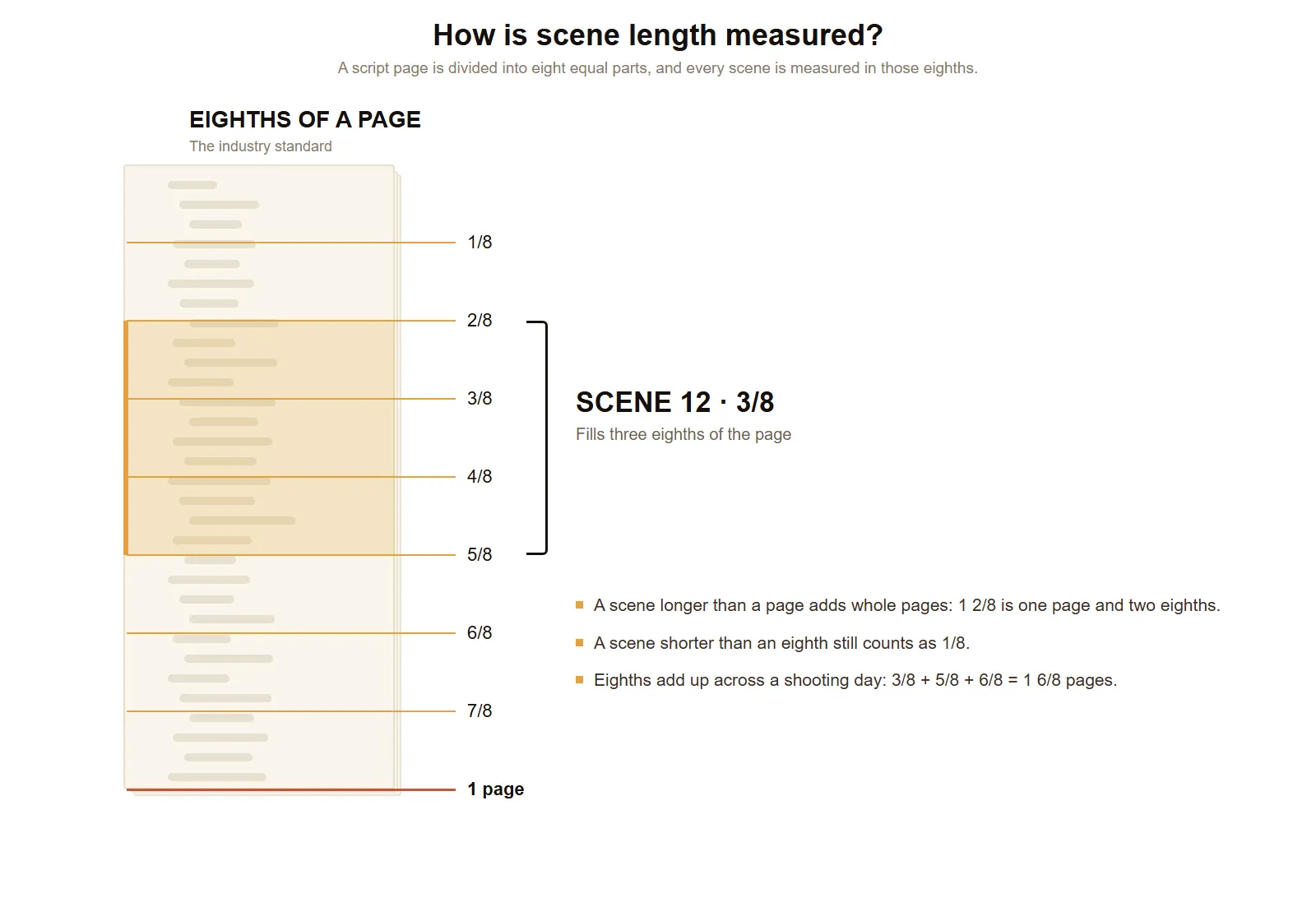
The industry standard is the eighths system, and it is the same in screenwriting software like Final Draft and in scheduling tools like StudioBinder. Each script page is divided by horizontal lines into eight equal parts from top to bottom. A scene’s length is written as the number of eighths it fills: 1/8, 3/8, 5/8, or a whole page. When a scene runs past one page, the extra eighths are added on, so you write 1 2/8 or 1 4/8.
A few rules of thumb a working AD follows:
- 1/8 to 3/8 of a page: short scenes, such as a few lines of action, a quick look or a single line of dialogue. A scene shorter than an eighth still counts as 1/8. It is never written as zero.
- 4/8 (half a page): the scene fills exactly half of the page.
- 5/8 to 7/8: dense scenes that take up almost the whole page on their own.
- 1 page: the scene fills the page from its first line to its last. If it runs onto the next page, the count keeps going, as in 1 2/8 or 1 4/8.
What do these numbers give you? When the AD or the production team builds the daily schedule, this is how they calculate how much will be shot that day. The lines you hear on set all the time, “We have 3 pages today” or “Today’s plan is 3 4/8”, come from exactly this. We find the total weight of those pages by adding up the space the scenes take. That keeps the risk of falling behind to a minimum and lets the production be planned realistically.
💡 A quick note from the set: When you measure page length, keep in mind the hidden weight of a production. Not every page takes the same time to shoot. Scenes with lots of background actors, stunts and action, car chases, special effects such as explosions and gunfire, or live musical performances can take hours or even days to shoot, even if they fill only a few lines on the page. Catching these extra-time details in the breakdown can save the whole crew later, when the shooting schedule is made.
4. Identify what each scene needs and enter it into the sheet
Now we come to the stage that demands the most attention and care, the one that takes the most patience and matters the most: finding every need inside the scenes one by one and entering them on the breakdown sheet.
The key principle here is to work in categories rather than throw everything into one bag. You list the cast, the extras, the props and any wardrobe or makeup detail specific to that scene, each in its own class. Separating needs like this keeps the breakdown from tiring the eye, and it gives you clean, pinpoint lists to share with the relevant departments (art, costume, production and others) in later stages. An important rule: each element lives in only one category. You don’t write the same item twice, once as a prop and once as set dressing, because that throws off the counts and the budget.
Here is what a breakdown divided into categories looks like in practice:
| Scene | INT/EXT | Location | Time | Pages | Synopsis | Cast | Vehicles | Props | Wardrobe | Set Dressing | SFX | Sound | Lighting |
|---|---|---|---|---|---|---|---|---|---|---|---|---|---|
| 1 | INT | OLD EDITING ROOM | NIGHT | 3/8 | Maya works at the editing desk in a dim room with her headphones on, then freezes at a strange warning from the sound recorder as its light starts blinking on its own. | MALE VOICE | Coffee Cup, Headphones, Editing Desk, Red Pen, Script Pages, Sound Recorder | Recorder Light Effect | Crackling Recording | ||||
| 2 | EXT | EMPTY STREET | NIGHT | 3/8 | Maya walks down the rainy street with a file and a flashlight as a parked minibus flashes its headlights. She stops, uneasy, and her phone rings: it is Owen. | MAYA | Minibus | File, Flashlight, Phone | Black Trench Coat | Rain Effect | Phone Ringing | Faulty Streetlight | |
| 3 | INT | OWEN'S CAR | NIGHT | 2/8 | Owen waits tensely in his car in the rain. Maya gets in, and the two talk about the phone calls they got and the file in their hands. | OWEN | Car | Camera, Notebook, Walkie-Talkie | Car Door Closing, Rain | ||||
| 4 | INT | TAILOR'S WORKSHOP | DAY | 3/8 | Sewing in the costume workshop, Iris starts at the sight of the script in Maya and Owen's hands; then they talk about the unworn red cape on the wall. | IRIS | Jacket, File, Needle, Tape Measure | Military Jacket, White Wedding Dress, Red Cape | Old Film Costumes, Fabric Rolls | ||||
| 5 | EXT | COAST ROAD | DAY | 3/8 | Maya, Owen and Iris walk along the windy shore while Owen takes photos. Maya studies the scene missing from the list; Iris hands her an old key and talks about the cancelled shoot. | MAYA, IRIS | Key, File, Camera | Lighthouse | Seagulls, Wind | ||||
| 6 | INT | LIGHTHOUSE | DAY | 2/8 | Climbing the damp stairs, Maya spots strange writing on the wall. The lighthouse shakes, and a metallic crash from below frightens the group. | OWEN | Flashlight | Dust Cloud | Metallic Crash | ||||
| 7 | INT | LIGHTHOUSE, ARCHIVE ROOM | DAY | 3/8 | Maya takes a film can down from a shelf and Owen opens it. Iris touches the burnt film and the scrap of red fabric inside and is moved. | IRIS | Film Can, Fabric Scrap, Burnt Film | Old Lighting Gear, Film Cans and Tapes, Broken Camera Tripod |
Let’s be realistic here. On episodic TV, with a page count to hit every week and prep measured in days, there is rarely time to pick up colored pencils and mark the script by hand. On feature films, commercials or streaming projects, where prep is longer and budget and time management are more flexible, the traditional method is still a classic. Marking the script by hand and “coding” it in colors helps a person know the story more deeply and think about every small detail one by one.
But at the pace of a TV series, speed and practicality matter more than that luxury. So the process usually runs through digital tools: scenes are scanned quickly, and the main elements go straight into the breakdown lists and a spreadsheet. The schedule, the cast plans and every department need to be informed on time, which means the breakdown has to be in hand as soon as possible.
Why is reading this closely so laborious, and so important? Because a tiny detail hidden between the lines of a script can turn into a huge operation, or a legal problem, at the shoot. Take a simple line of action like “Maya lies in bed, reading a novel.” You can’t log it as just an ordinary book. The cover will be clearly visible on screen, so there is a copyright clearance to get. This is where the breakdown and the shared responsibility on a production come in. The detail should be entered on the breakdown sheet early, and whoever handles clearances and legal matters should have caught it while reading the script too. With that double check, the clearance is easy to get well before shoot day. If it can’t be cleared, the cover can be disguised or a different book chosen from the start, and a possible crisis is avoided together.
5. Turn the breakdown data into reports and department lists
After you have gone through every scene line by line and entered the needs, it is time to share this raw information with the other teams. This is the stage where all the detail gathered in the breakdown spreads across the whole production and the division of work becomes clear.
The breakdown reports you end up with are essentially summary tables that show all of a scene’s needs on a single page. On a production, reporting happens in two ways.
The traditional method (Excel, Numbers and manual tables): Why are breakdowns kept in spreadsheets like Excel, or Numbers for Mac users, and not in a word processor? The secret is in the logic of rows, columns and cells. A table lets you write each department (art, wardrobe, cast and so on) in its own column, and then use filtering to pull out just the art department’s list or just wardrobe’s in one click. In a word processor your chances of filtering or splitting by department are limited.
The newer method (automatic reporting with Dekupa): This is where AI-powered Dekupa comes in. With a weekly page count to hit, or in any workflow where there is no time, you can’t produce the really detailed breakdown you’d be happy with, and on top of that you have to copy information into Excel one item at a time for hours or days. Dekupa steps in here, gathering that scattered work in one place and speeding it up, so you finally have time to give the script the attention it deserves.
In short, Dekupa lets you breathe. You upload your script, and within seconds Dekupa analyzes it. It sorts every element, from cast and props to the art list, wardrobe and VFX notes, into 21 different categories and reports them department by department. All that’s left is to download the ready reports in one click and share them with the teams.
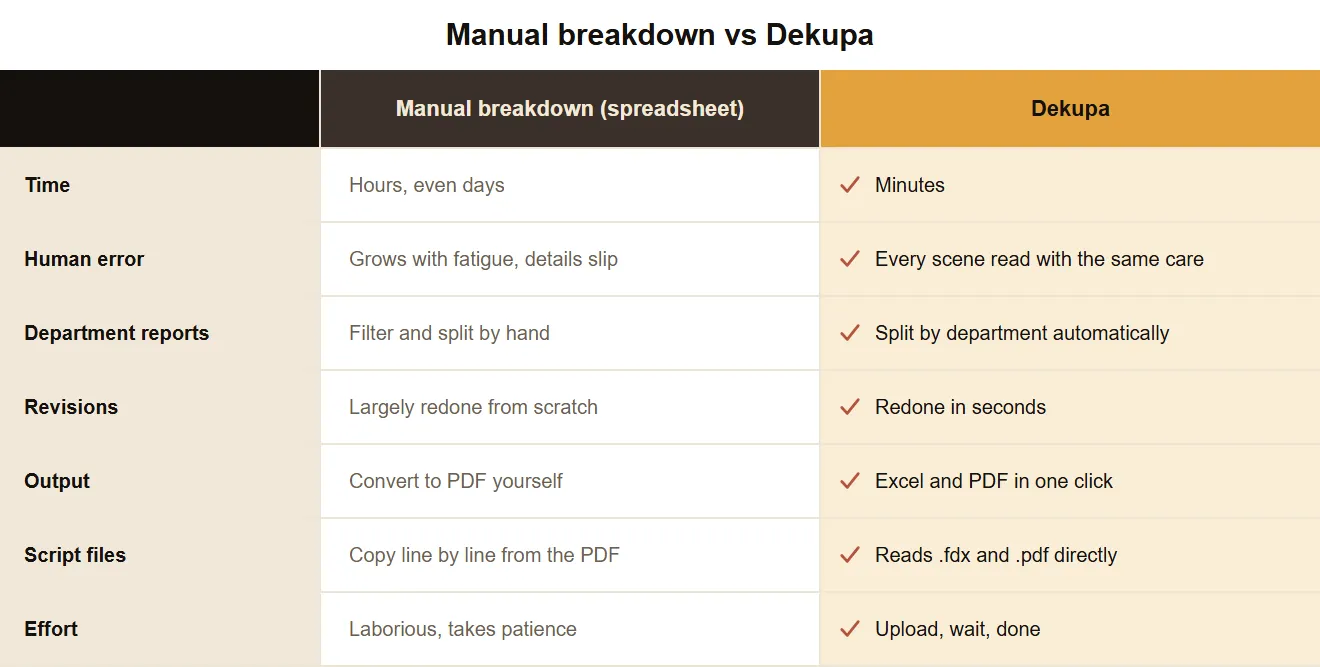
With these reports, every team first sees clearly the needs that are its own responsibility. That makes the preparation before the shoot far more orderly, with fewer missed details and the smallest possible margin for error.
A script breakdown is one of the least visible and most decisive jobs on a production. A well-made breakdown gives everything on set, from the shooting schedule and budget to the call sheet and department prep, a solid foundation. When it is done, the next job is to build the shooting schedule, and that job is as easy as your breakdown is clean and complete.
Frequently asked questions
- Who does the script breakdown?
- On most productions the first assistant director (1st AD) does it, often with the 2nd AD or the production office. On a feature, the line producer usually makes a rough first pass to build the budget, and the 1st AD refines it once the director is on board. Department heads such as art, costume and hair and makeup then pull their own lists from it.
- How is scene length measured in eighths of a page?
- Each script page is divided into eight equal horizontal parts, and a scene's length is written as the number of eighths it fills: 3/8, 5/8, 1 page, 1 2/8 and so on. A scene shorter than an eighth still counts as 1/8. Adding up the eighths gives the page count for each shooting day, which is how a schedule gets balanced.
- Is a breakdown done by hand or with software?
- For many years it was done with colored pencils or highlighters and then typed into spreadsheets, and plenty of productions still work that way. Dekupa is a newer tool: it reads the script, builds the breakdown automatically in seconds, and leaves you to review it, so prep moves faster and stays organized.
- Why is a breakdown usually kept in a spreadsheet?
- Because rows, columns and cells let you put each department in its own column and filter, so every team gets only its own list. A word processor can't filter or split by department.
- What is a breakdown sheet?
- A breakdown sheet is a one-page summary of a single scene. It lists the scene number, heading, page length and synopsis, then every element the scene needs, such as cast, extras, props, wardrobe, vehicles and effects. The stripboard, budget and call sheets are all built from these sheets.
- How does a breakdown work for indie films, shorts and documentaries?
- The breakdown still gets done, but there may not be a large team to do it. A director, producer or someone on the crew often takes it on. What matters is not who does it but that the needs are planned before the shoot, so the crew works in an orderly way and many problems are solved before they reach the set.
- How long does a script breakdown take?
- It depends on the length of the script and the method. A detailed breakdown done by hand, line by line, can take hours or even days on a feature. With Dekupa the same job takes minutes, and you spend the time you saved on checking and creative work.